
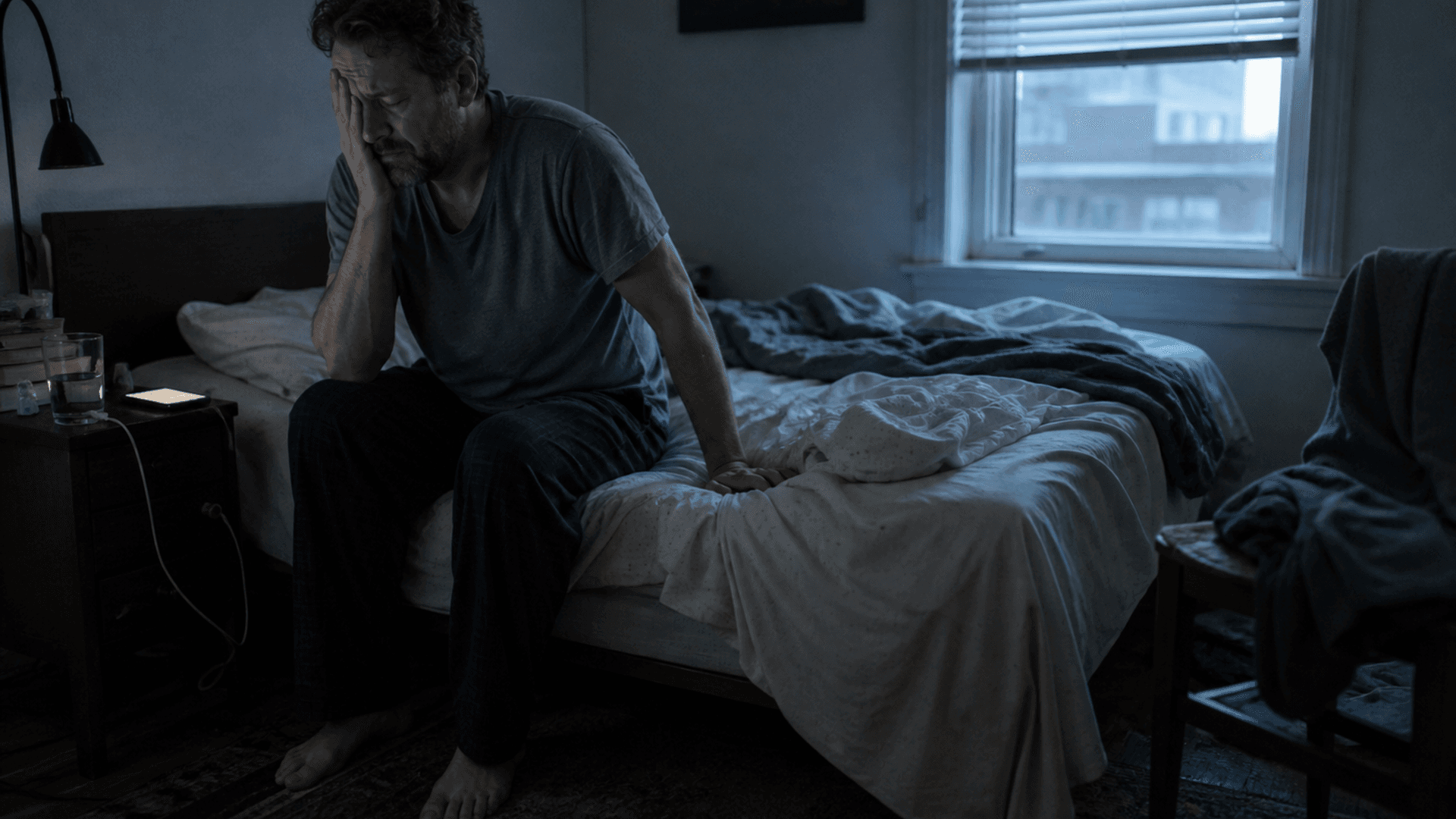
Glutathione and Sleep After 40: The Antioxidant Cost of Short Nights

Sarah Chen
Medical Content Advisor · September 1, 2026
Glutathione and sleep are closely linked. Research suggests even one short night lowers this master antioxidant. Here is what that may mean after 40.
There is a particular kind of tired that arrives in your forties. It is not the dramatic exhaustion of an all-nighter in your twenties, the kind you shook off with a coffee and a shower. It is quieter and more stubborn. You slept six hours instead of eight, and three days later you still feel like you are running a slightly older version of yourself. The relationship between glutathione and sleep may help explain why that recovery gap keeps widening, and why the same short night costs more at 45 than it did at 25.
Glutathione is often called the body's master antioxidant. It is a small molecule made of three amino acids, produced inside your own cells, and it does the unglamorous work of neutralizing the reactive byproducts of being alive. What researchers have found over the past two decades is that this system is not static across the day. It rises and falls with your sleep, and when sleep is cut short, glutathione is one of the first things to drop.
What Glutathione and Sleep Have to Do With Each Other
Every waking hour, your cells generate reactive oxygen species as a normal consequence of turning food and oxygen into energy. In small amounts these molecules are useful signals. In excess they damage lipids, proteins, and DNA. Glutathione is the primary buffer against that accumulation, and it works alongside enzymes like superoxide dismutase and catalase to keep the balance.
Sleep appears to be when the resupply happens. During deep sleep, metabolic rate drops, the brain runs its glymphatic clearance, and antioxidant reserves are replenished. Sleep is not passive downtime. It is a scheduled maintenance window, and glutathione is one of the tools the maintenance crew uses.
Cut the window short, and the work does not get done. That is the mechanism researchers have been probing, and the human data is more direct than most people expect.
One Short Night Is Enough to Move the Needle
In a controlled study published in PLoS ONE, researchers kept nineteen healthy young adults awake for a single night and measured their plasma redox metabolites the following morning.[1] After just one night of total sleep deprivation, plasma glutathione dropped significantly, along with ATP, cysteine, and homocysteine. All of these changes reached statistical significance at p < 0.01. These were young, healthy participants with no underlying illness, and one night was enough.
A separate study in Frontiers in Molecular Neuroscience followed twenty healthy male physicians through one night of sleep deprivation and one night of recovery sleep.[2] After deprivation, markers of oxidative damage rose while glutathione and superoxide dismutase fell. The participants also became measurably more sensitive to pain. After a single night of recovery sleep, their pain thresholds returned to baseline, but their oxidative markers had only partially recovered.
That mismatch matters. It suggests you can feel restored before you are biochemically restored, which is precisely the trap of a chronically under-slept week.
The Effect Accumulates Over Weeks
Single-night studies are dramatic but artificial. Most people are not pulling all-nighters. They are losing forty-five minutes a night, five nights a week, indefinitely.
A 2025 study in the journal SLEEP addressed exactly that pattern using proton magnetic resonance spectroscopy to measure glutathione directly in living brain tissue.[3] Researchers found that greater cumulative weekly sleep loss was associated with lower glutathione concentrations in the anterior cingulate cortex (β = −0.28, p = .01), a region heavily involved in attention, emotional regulation, and decision making. The relationship held when glutathione was expressed relative to creatine (β = −0.29, p = .008).
This was the first in vivo evidence that ordinary, real-world sleep debt tracks with reduced antioxidant capacity in the brain itself. Not in a test tube. Not after an experimental all-nighter. In people living normal weeks.
Recovery Sleep Repairs Some of It
The encouraging half of this research is that the system is responsive. In a controlled animal study examining antioxidant defenses across five and ten days of sleep loss, liver glutathione and catalase fell by roughly 23 to 36 percent.[4] When the animals were allowed to sleep normally again, antioxidant content in the liver returned to normal, and enzymatic antioxidant activity in liver and heart tissue actually rose above baseline. The authors concluded:
"Restoration of antioxidant balance is a property of recovery sleep."
That is a rodent study, so the numbers do not transfer directly to humans. But paired with the human deprivation data, it points to the same idea from the other direction: sleep is not just when antioxidant reserves stop being spent, it is when they are actively rebuilt.
The catch, as the physician study showed, is that one good night does not fully undo a stretch of bad ones. Recovery is real but incomplete, and it lags behind how you feel.
Sleep Apnea Turns This Into a Nightly Cycle
For a significant slice of adults over 40, especially men, the problem is not time in bed. It is what happens during it. Obstructive sleep apnea produces repeated cycles of oxygen desaturation and reoxygenation through the night, which is a near-perfect recipe for oxidative stress.
The antioxidant signature shows up clearly in patients. A study of 41 newly diagnosed, untreated patients with obstructive sleep apnea found increased protein oxidative damage and impaired antioxidant defenses, including altered total glutathione.[5] Research in patients with the condition has also found significantly reduced whole blood glutathione compared with controls, alongside lower total antioxidant status that improved with CPAP treatment.[6]
More interesting is what happens when antioxidant support is added on top of standard care. A 2024 systematic review and meta-analysis pooled six studies covering 160 patients with obstructive sleep apnea who received antioxidant therapy.[7] The pooled analysis found a significant improvement in flow-mediated dilatation, a measure of blood vessel function, of 2.16 percent (95% CI 1.65 to 2.67, I² = 0%, p < 0.001). The reviewed studies also reported reduced malondialdehyde, increased reduced glutathione, and improvements in daytime sleepiness scores and oxygen desaturation index, with no significant adverse events.
These are small studies in a specific clinical population, and they do not establish that antioxidants treat sleep apnea. They do suggest that the oxidative component of poor sleep is a modifiable target rather than an inevitability.
Why the Math Changes After 40
Two curves cross somewhere in midlife. Endogenous glutathione production tends to decline with age, while cumulative oxidative load tends to rise. At the same time, sleep architecture shifts: slow-wave sleep decreases, nighttime awakenings increase, and the deep restorative stages that appear to matter most for antioxidant restoration get shorter.
The practical result is a narrower margin. A 25-year-old with a robust glutathione pool and abundant deep sleep absorbs a bad week without much consequence. A 48-year-old with a smaller reserve, less slow-wave sleep, and a decade of accumulated exposure has less buffer. The same behavior produces a different outcome, which is often what people are describing when they say recovery "just takes longer now."
This is also why the fatigue of midlife sleep debt so often feels systemic rather than local. Oxidative stress is not confined to one tissue. It touches vascular function, immune signaling, mitochondrial efficiency, and cognitive clarity, which is a reasonable description of the complaints people actually bring to a physician.
What Actually Helps
The first intervention is unglamorous and non-negotiable: protect the sleep window. No antioxidant strategy compensates for chronically sleeping five hours. Consistent sleep and wake times, a genuinely dark and cool room, limiting alcohol within three hours of bed (alcohol is particularly effective at suppressing the deep sleep stages this article is about), and getting bright light exposure early in the day all support the architecture that does the repair work.
The second is to rule out sleep apnea if the signs are there. Loud snoring, witnessed pauses in breathing, morning headaches, or daytime sleepiness despite adequate time in bed all warrant a conversation with a physician and possibly a sleep study. Treating apnea addresses the oxidative problem at its source.
The third is supporting the antioxidant system itself. Dietary sulfur-containing amino acids from foods like eggs, garlic, cruciferous vegetables, and quality protein provide the raw material for glutathione synthesis. Some patients also work with their physician on direct glutathione support. Oral glutathione is poorly absorbed, which is why physician-supervised injectable protocols exist. At RenuviaRX, glutathione is one of the injectable therapies our board-certified physicians evaluate patients for, alongside NAD+, B12 with MIC, and L-carnitine, always as part of a broader picture rather than a standalone fix.
Worth being clear about what the evidence does and does not show. The research above demonstrates that sleep loss lowers glutathione and that antioxidant status tracks with sleep quality. It does not demonstrate that raising glutathione improves sleep. Those are different claims, and only the first is well supported today.
The Takeaway
Sleep is when your body does its antioxidant housekeeping, and glutathione is central to that process. Human studies suggest a single short night measurably lowers it, that weekly sleep debt tracks with lower glutathione in the brain, and that recovery sleep restores the balance more slowly than it restores how you feel. After 40, with a smaller reserve and less deep sleep to work with, that gap is simply harder to close.
If persistent fatigue, poor recovery, and foggy mornings have become your normal, it is worth investigating rather than absorbing. A conversation with a physician about your sleep, your labs, and whether targeted support makes sense for you is a more useful step than another cup of coffee.
These statements have not been evaluated by the FDA. This content is for informational purposes only and does not constitute medical advice.
References
- Trivedi MS, Holger D, Bui AT, Craddock TJA, Tartar JL. Short-term sleep deprivation leads to decreased systemic redox metabolites and altered epigenetic status. PLoS ONE. 2017;12(7):e0181978. https://doi.org/10.1371/journal.pone.0181978
- Sleep deprivation and recovery sleep affect healthy male resident physicians' pain sensitivity and oxidative stress markers. Frontiers in Molecular Neuroscience. 2022;15:937468. https://doi.org/10.3389/fnmol.2022.937468
- Weekly sleep loss is associated with reduced cortical glutathione and antioxidant capacity in adolescents. SLEEP. 2025;48(11):zsaf245. https://doi.org/10.1093/sleep/zsaf245
- Everson CA, Laatsch CD, Hogg N. Antioxidant defense responses to sleep loss and sleep recovery. American Journal of Physiology: Regulatory, Integrative and Comparative Physiology. 2005;288(2):R374-R383. https://doi.org/10.1152/ajpregu.00565.2004
- Oxidative stress and inflammatory markers in newly diagnosed patients with obstructive sleep apnoea syndrome. Sleep Medicine. 2012;13(6):632-636. https://doi.org/10.1016/j.sleep.2011.10.030
- Barceló A, Barbé F, de la Peña M, et al. Antioxidant status in patients with sleep apnoea and impact of continuous positive airway pressure treatment. European Respiratory Journal. 2006;27(4):756-760. https://doi.org/10.1183/09031936.06.00067605
- Antioxidant therapies for obstructive sleep apnea: a systematic review and meta-analysis. 2024. PMID: 38740632. https://pubmed.ncbi.nlm.nih.gov/38740632/
Ready to start your wellness journey?
Take a free online assessment and get physician-supervised therapy delivered to your door.
GET STARTED →