
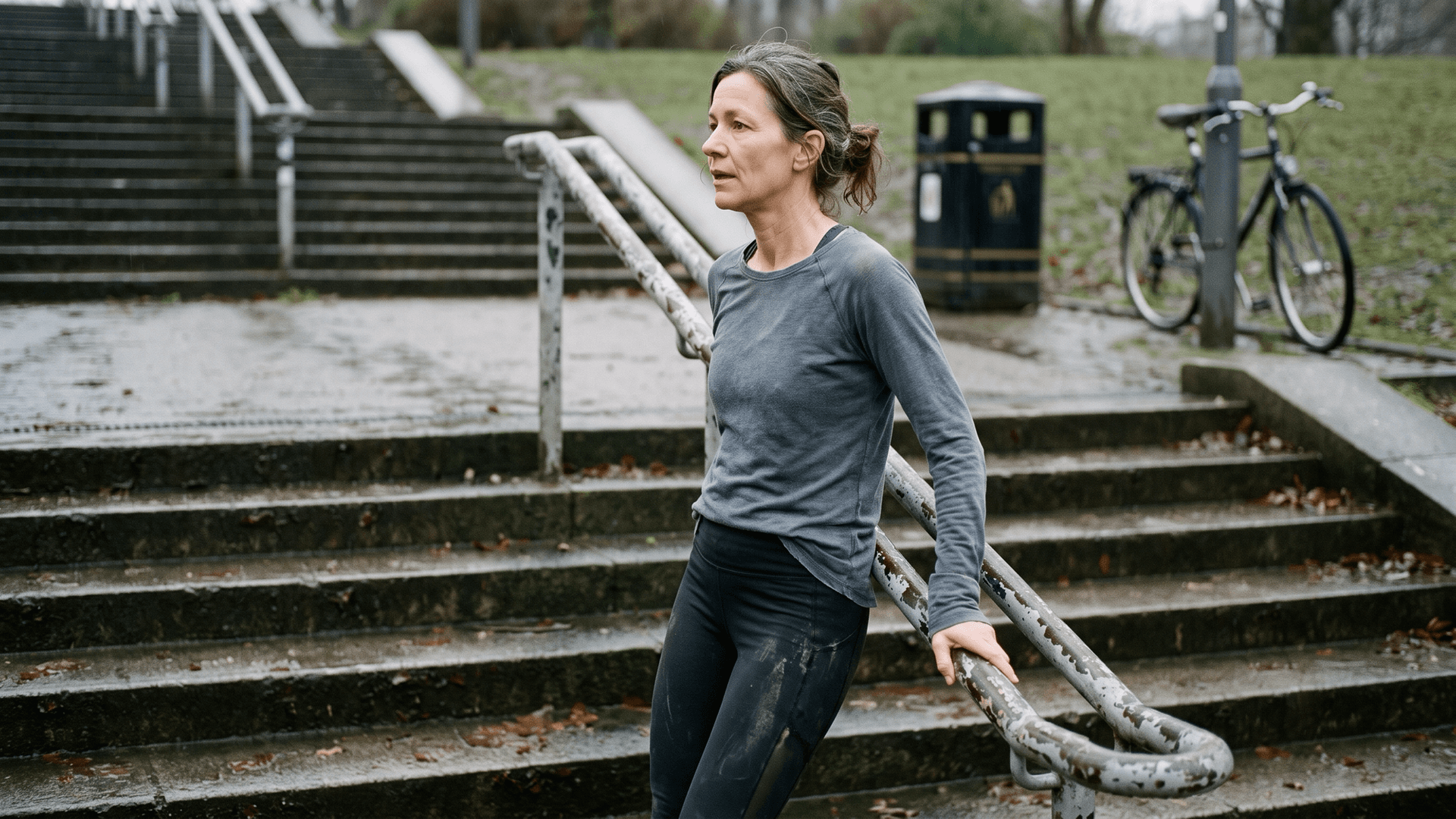
Visceral Fat After 40: Why Deep Belly Fat Matters More Than the Scale

Sarah Chen
Medical Content Advisor · September 22, 2026
Visceral fat after 40 drives metabolic risk more than body weight. Here is what research shows about menopause, fat oxidation, exercise, and L-carnitine.
There is a particular kind of frustration that tends to arrive somewhere in the mid-forties. Your weight has barely moved in a decade. Your clothes are roughly the same size. And yet the waistband tells a different story than the bathroom scale does, and the shape of your midsection has quietly changed in a way you cannot quite explain. Visceral fat after 40 is usually the reason. It is the deep abdominal fat that packs in around the liver, pancreas, and intestines, and unlike the soft layer you can pinch between your fingers, it does not behave like passive storage. It behaves more like an active organ with strong opinions about your metabolism.
That distinction matters more than most people realize. Two adults can weigh the same, wear the same size, and carry very different metabolic risk depending on where their fat sits. The scale cannot see the difference. Your bloodwork usually can.
Subcutaneous Fat Stores Energy, Visceral Fat Sends Signals
Body fat is not one tissue with one job. The subcutaneous layer sitting just under the skin, particularly around the hips and thighs, is largely a buffer. It absorbs surplus energy and keeps it out of circulation. Visceral fat, packed inside the abdominal cavity, is metabolically louder. It is more inflammatory, more insulin resistant, and it drains directly into the portal vein that feeds the liver, which means the free fatty acids and signaling molecules it releases arrive at the liver first and in concentrated form.
A clinical review of adipose distribution summarized the pattern clearly: visceral and ectopic fat accumulation is associated with adverse cardiometabolic consequences, gluteal and femoral fat is actually associated with lower risk, and subcutaneous abdominal fat sits somewhere neutral in between [1]. The same review pointed to a mechanism that explains a lot of midlife body composition change, which is that when subcutaneous tissue loses its ability to expand in response to a positive energy balance, the surplus has to go somewhere else. It goes to the viscera, and to the liver, muscle, and heart as ectopic fat.
This is why waist circumference has held up as a useful clinical marker while body mass index has not. BMI treats a kilogram as a kilogram. Your liver does not.
Why Visceral Fat After 40 Becomes Harder to Shift
Three things tend to change at once in midlife, and they compound. Lean muscle mass declines, which shrinks the tissue doing most of your resting fuel burning. Daily movement quietly drops, often years before anyone notices. And the hormonal environment that helped partition fat toward the hips and thighs begins to shift.
None of these is dramatic on its own. A few hundred fewer calories burned per day, a modest reduction in step count, a gradual change in sex hormone levels. Stacked across five or ten years, they reshape where your body puts fat without necessarily changing how much of it you carry.
What the Menopause Data Actually Shows
One of the cleaner datasets on this comes from a four year longitudinal study at the Pennington Biomedical Research Center, which followed 156 healthy women who were premenopausal at baseline, measuring body composition by DXA and abdominal fat by CT every year [2]. The design matters, because it allowed researchers to separate what aging does from what the menopausal transition does.
All of the women gained subcutaneous abdominal fat over the four years. Only the women who became postmenopausal gained visceral fat.
Middle-aged women gained SAT with age, whereas menopause per se was associated with an increase in total body fat and VAT. [2]
Twenty-four hour energy expenditure and sleeping energy expenditure both declined with age across the whole group, but the drop in sleeping energy expenditure was about 1.5 times greater in the women who transitioned through menopause. Physical activity fell significantly around two years before menopause and stayed low afterward.
Men are not exempt from visceral accumulation with age, but the trajectory tends to be more gradual and less tied to a single hormonal threshold.
The Fat Oxidation Bottleneck
The most interesting number in that study was not about fat storage at all. Fat oxidation, meaning the rate at which the body actually burns fatty acids for fuel, dropped by 32 percent in the women who became postmenopausal. It did not change in the women who remained premenopausal [2].
Fat oxidation is a mitochondrial process. Long chain fatty acids cannot simply drift into a mitochondrion. They have to be actively escorted across the inner mitochondrial membrane, and that escort service is carnitine dependent. Carnitine palmitoyltransferase enzymes attach fatty acids to carnitine, shuttle the pair across the membrane, and release the fatty acid on the other side where beta oxidation can finally begin.
When fat oxidation capacity falls, the same meal and the same workout produce different outcomes. More of the fat you eat and mobilize gets re-esterified and stored rather than burned, and the preferred storage site in midlife is increasingly visceral. This is the mechanistic bridge between "my metabolism changed" as a feeling and what is actually measurable in a calorimeter.
What Moves Visceral Fat: The Exercise Evidence
Here is the genuinely good news. Visceral fat is more metabolically responsive than subcutaneous fat, which means it tends to be the first fat depot to shrink when you change your inputs.
A systematic review and meta-analysis pooled 15 trials covering 852 participants to isolate the effect of exercise on visceral adipose tissue without any caloric restriction [3]. The pooled standardized mean difference was -0.497, with a confidence interval of -0.655 to -0.340 and a p value below 0.001. In plain terms, exercise alone shifted visceral fat meaningfully, and it did so without anyone counting a calorie.
The subgroup analysis found that aerobic training at moderate or high intensity had the strongest effect, with reductions exceeding 30 square centimeters of visceral fat on CT in women and 40 square centimeters in men, in some cases within 12 weeks. The authors concluded:
Aerobic training of moderate or high intensity has the highest potential to reduce visceral adipose tissue in overweight males and females. [3]
Resistance training belongs in the plan too, not because it outperforms aerobic work on visceral fat specifically, but because it defends the lean mass that sets your metabolic floor.
Where L-Carnitine Enters the Picture
If fat oxidation capacity is part of the midlife problem, the carnitine shuttle is a reasonable place to look. Carnitine is not a stimulant and not a fat blocker. It is the transport molecule that determines whether mobilized fatty acids actually reach the machinery that burns them.
The clinical literature on supplementation is real, but it is modest, and it deserves an honest reading rather than a promotional one.
The largest synthesis to date pooled 37 randomized controlled trials with 2,292 participants and ran a dose-response analysis [4]. L-carnitine supplementation produced a significant reduction in body weight of about 1.21 kg, a BMI reduction of 0.24, and a fat mass reduction of roughly 2.08 kg. Notably, it did not produce a significant effect on waist circumference or body fat percentage in the pooled analysis, and when the researchers restricted to high quality trials only, the body weight effect was the one that held. The dose-response curve suggested around 2,000 mg per day as the point of maximum effect in adults.
A smaller randomized study in 30 patients with metabolic syndrome, average age 47, looked at intravenous L-carnitine during a supervised fasting protocol [5]. The carnitine group lost more weight, 4.6 kg versus 3.2 kg, and showed a considerably larger reduction in waist circumference, 5.0 cm versus 1.7 cm. Insulin concentrations and liver enzyme markers also moved more favorably, and self-reported physical fatigue and fatigue severity improved in the carnitine group while worsening in controls. It was a small, short, single-blind pilot, so it should be read as a signal rather than a verdict.
Fatigue shows up again in a double-blind, placebo-controlled trial of 60 patients with hypothyroidism who remained tired despite adequate thyroid hormone replacement [6]. After 12 weeks of L-carnitine, mental fatigue scores improved significantly compared with placebo, and 75 percent of the carnitine group showed improvement on the fatigue severity scale versus 20 percent on placebo, although the overall between-group score change did not reach significance.
And a 2025 trial in 41 trained cyclists found that four weeks of acetyl-L-carnitine with alpha-lipoic acid did not improve aerobic or anaerobic performance at all, despite lowering blood lactate after high intensity efforts [7]. That null result is worth stating plainly. Carnitine is not an ergogenic shortcut for well-trained athletes, and the people most likely to see a difference appear to be those with reduced metabolic flexibility rather than those already running an optimized system.
At RenuviaRX, L-Carnitine is offered as a physician-supervised injectable compounded by Strive Pharmacy, which sidesteps the absorption ceiling that limits oral carnitine, but the honest framing stays the same: it supports a pathway, it does not replace the training stimulus that drives the result.
A Twelve Week Framework You Can Measure
Visceral fat responds to consistency, not intensity theatrics. A workable approach looks like this.
Measure something real. Waist circumference at the navel, first thing in the morning, same tape, once a week. If you have access to DXA or a CT-derived visceral fat score, better still. Do not use daily scale weight as your primary signal, because it will mislead you for weeks at a time.
Build an aerobic base. Aim for 150 to 200 minutes per week at an intensity where conversation is possible but effortful. This is the input with the strongest direct evidence against visceral fat [3].
Add two resistance sessions. Compound movements, progressive load. This protects the lean mass that keeps your resting energy expenditure from sliding further.
Protect sleep and moderate alcohol. Both influence insulin sensitivity and where the body chooses to store surplus energy.
Then give it twelve weeks before you judge it. That is roughly the timeline over which the exercise trials detected measurable visceral change.
The Bottom Line
Visceral fat after 40 is a distribution problem more than a willpower problem. The hormonal and metabolic shifts of midlife move fat inward and slow the rate at which you burn it, and the scale is largely blind to both. The research points consistently toward the same levers: moderate to vigorous aerobic work, preserved muscle, and metabolic support for the fat oxidation pathway that quietly loses capacity with age.
If you are doing the work and still feel like your metabolism is not cooperating, it may be worth reviewing your labs and your options with a clinician who treats this as a physiology question rather than a discipline question. The RenuviaRX medical team works with board-certified physicians through a short online questionnaire, and consultations are entirely telehealth based.
These statements have not been evaluated by the FDA. This content is for informational purposes only and does not constitute medical advice.
References
Sam S. Differential effect of subcutaneous abdominal and visceral adipose tissue on cardiometabolic risk. Hormone Molecular Biology and Clinical Investigation. 2018;33(1). https://doi.org/10.1515/hmbci-2018-0014
Lovejoy JC, Champagne CM, de Jonge L, Xie H, Smith SR. Increased visceral fat and decreased energy expenditure during the menopausal transition. International Journal of Obesity. 2008;32(6):949-958. https://doi.org/10.1038/ijo.2008.25
Vissers D, Hens W, Taeymans J, Baeyens JP, Poortmans J, Van Gaal L. The effect of exercise on visceral adipose tissue in overweight adults: a systematic review and meta-analysis. PLoS ONE. 2013;8(2):e56415. https://doi.org/10.1371/journal.pone.0056415
Talenezhad N, Mohammadi M, Ramezani-Jolfaie N, Mozaffari-Khosravi H, Salehi-Abargouei A. Effects of l-carnitine supplementation on weight loss and body composition: a systematic review and meta-analysis of 37 randomized controlled clinical trials with dose-response analysis. Clinical Nutrition ESPEN. 2020;37:9-23. https://doi.org/10.1016/j.clnesp.2020.03.008
Zhang JJ, Wu ZB, Cai YJ, Ke B, Huang YJ, Qiu CP, Yang YB, Shi LY, Qin J. L-carnitine ameliorated fasting-induced fatigue, hunger, and metabolic abnormalities in patients with metabolic syndrome: a randomized controlled study. Nutrition Journal. 2014;13:110. https://doi.org/10.1186/1475-2891-13-110
An JH, Kim YJ, Kim KJ, Kim SH, Kim NH, Kim HY, Kim NH, Choi KM, Baik SH, Choi DS, Kim SG. L-carnitine supplementation for the management of fatigue in patients with hypothyroidism on levothyroxine treatment: a randomized, double-blind, placebo-controlled trial. Endocrine Journal. 2016;63(10):885-895. https://doi.org/10.1507/endocrj.EJ16-0109
de Rozas A, Pérez-Díaz JJ, Muros JJ, Sánchez-Muñoz C, Rufían-Henares JÁ, Zabala M, Salas-Montoro JA. l-Carnitine and alpha-lipoic acid fail to improve anaerobic and aerobic performance in trained cyclists despite a reduction in blood lactate concentration. Nutrients. 2025;17(13):2227. https://doi.org/10.3390/nu17132227
Ready to start your wellness journey?
Take a free online assessment and get physician-supervised therapy delivered to your door.
GET STARTED →